Make Speakeasies Harder, Damnit
D&D, suspension of disbelief, thinking like a character

There is a “speakeasy” in my city. It is called Grandstaff and Stein and its name is written in HUGE letters on the side of the building. The windows to the inside from the street are all curtained, and when you step in the front door you arrive in a remarkably cramped room where every single wall is bookshelves. And then - surprise! Behind some of the bookshelves is a “secret” door.
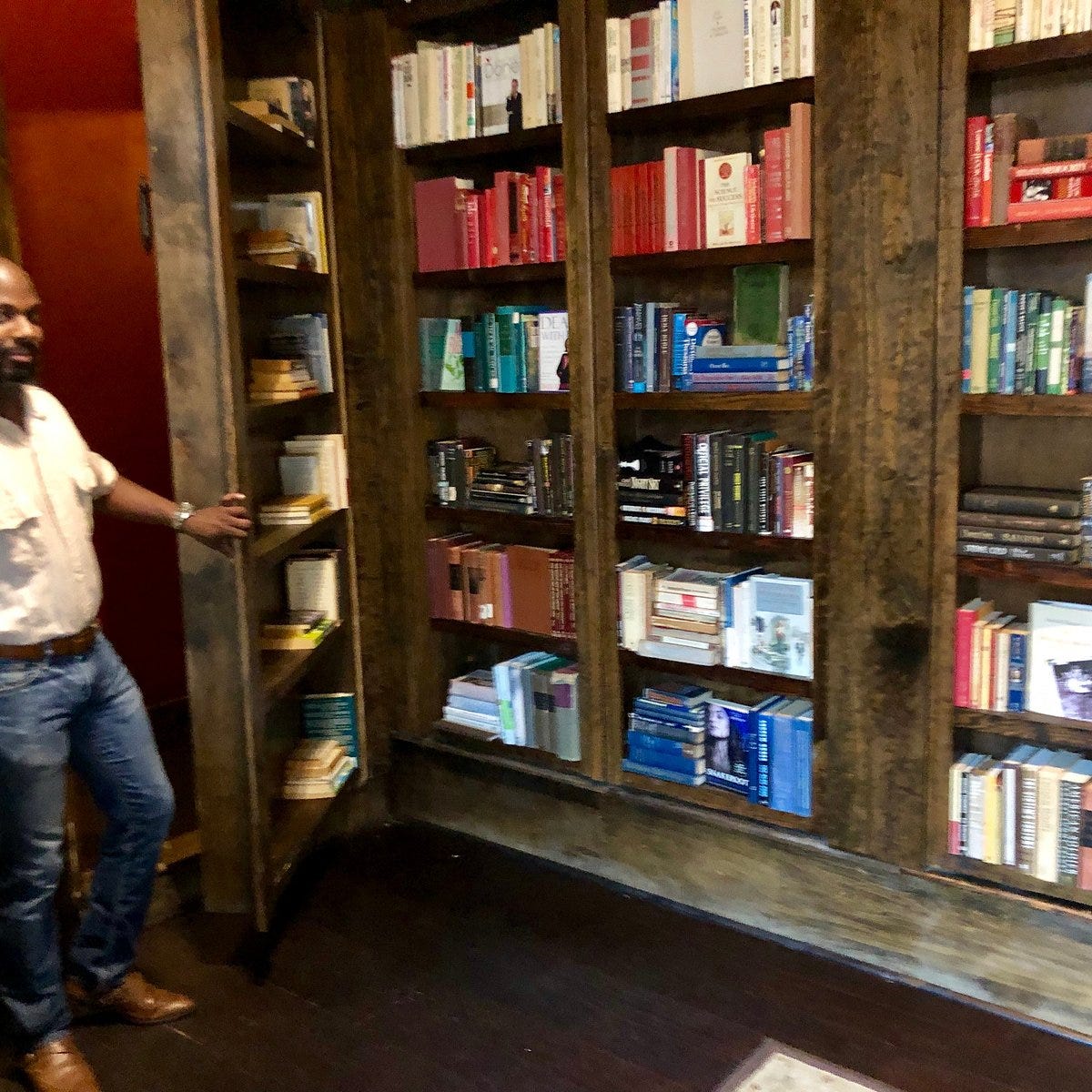
Now I may be a simple country ‘stacker unfamiliar with the ways of the big city - but that’s not a speakeasy?? Not even a good approximation of one?? This type of experience depends on some suspension of disbelief, but help a guy out! One extremely tiny room full of books is all that’s in this huge building with a BIG advertisement for a not-very-bookstore-sounding name? Give me a break. The restaurant itself is B+, they have solid food and a respectable cocktail program, but nothing about it feels like you “found” something. It feels like you walked through a bookshelf to get to dinner.
This is not an indictment of the whole category of 2020s speakeasy.1 I have been to some that I thought were very surprising and exciting! The Study is hidden in the back of a restaurant in Williamsburg, VA and feels appropriately lit/decorated/menu’d for a small, secret place. The Alley Light in Charlottesville does not even brand itself as a speakeasy, but it is tricky enough to find, with an interior winding and plush enough that you do feel secreted away. Perhaps my favorite that I’ve been to is Red Ribbon Society, which sits at the end of several winding hallways in the basement of a hotel. This one actually did feel hidden - walking into it felt like being let in on a secret.
What’s the difference? All these places have websites and google maps entries. Nothing is truly hidden. The establishment is playing a game of pretend with us—imagine if this was actually a secret. What I think many speakeasies get wrong is: it’s not easy to play a good game of pretend. JRR Tolkien, the seminal pretend-world-maker-upper, said as much:
Anyone inheriting the fantastic device of human language can say the green sun. Many can then imagine or picture it. But that is not enough… to make a Secondary World inside which the green sun will be credible, commanding Secondary Belief, will probably require labour and thought, and will certainly demand a special skill, a kind of elvish craft.
This idea of Secondary Belief is introduced by Tolkien earlier in the work as an argument against the very concept of suspension of disbelief.
[the writer] makes a Secondary World which your mind can enter. Inside it, what he relates is “true”: it accords with the laws of that world. You therefore believe it, while you are, as it were, inside. The moment disbelief arises, the spell is broken; the magic, or rather art, has failed. You are then out in the Primary World again, looking at the little abortive Secondary World from outside. 2
Without getting into an argument about whether or not themed restaurants are art, I’ll say that a good speakeasy keeps you contained in its Secondary World.3 Rather than requiring suspension of disbelief, they put enough “labour and thought” into their setup that you experience Secondary Belief and enjoy the satisfaction of having found a secret and being let into a place that is exclusive.
Ultimately, that’s what many great experiences offer: beyond the pure enjoyment of the thing itself, there is a sense of accomplishment at having worked for it. Friction in the travel makes the destination more meaningful. Myriad activities involve creating difficulty for ourselves just to overcome it (see Type 2 Fun), but it’s especially important in playing pretend. It’s a fine line: adding friction that doesn’t feel arbitrary. Anybody who has run a game of Dungeons and Dragons knows this difficulty firsthand.
Conflict, Plot, Stories, Being a Character
First thing you gotta do in this section of the post is watch ~90 seconds of Brennan Lee Mulligan talk brilliantly about D&D, playing a character, and how an effective Game Master creates a game that is fun for their players by frustrating their players’ characters. (If you really don’t want to, I’m going to try to paraphrase and build on it below, but I do recommend watching.)4
All you need to know about D&D to watch this video is that it is a make-believe game for grownups where there are players, who pretend to be a singular character within the game, and Game Masters (GMs) who pretend to be the world, the villains, the monsters, and basically everything else. It is a collaborative game in the sense that the players want to “win” by having their characters succeed, but the GM is not striving to “beat” their players, just to create the best story possible for them.
The key concept here is the tension between what a player wants and what their character wants. The player wants an epic adventure, full of conflict and danger. The character wants to, for example, not leave the Shire, and if they have to leave the Shire they’d like the journey to be quick and painless. Minimally dangerous or epic.
As far as storytelling formats go, D&D/tabletop is unique to the extent that players are simultaneously trying to:
Be immersed in a character mindset where the best possible outcome is swift, easy resolution
Have a writer mindset where the best outcome is a winding, obstacle-laden path to success that forces characters to grow, change, and overcome (what Brennan refers to in the video as an arc)
A writer must understand character mindset to have them act in understandable ways, but does not need to inhabit it. An actor does not need to consider writer mindset; the difficulties they must face are already present in the script.
Brennan resolves some of this tension by positing that it is the Game Master’s responsibility to satisfy the players’ writer mindset by putting obstacles in the path of the characters. This way, the characters can always be pursuing a fast, easy resolution, but are “forced” by the story to encounter hardship and difficulty.
This rhymes with Tolkien’s points about Secondary Belief: the internal logic of a D&D game requires players to pilot their characters faithfully towards an efficient and un-storied resolution. If Player A’s character says, “What say we stop to fight this dragon? We have nothing to gain in slaying it - but it could be fun!” the other characters should rightfully say “you’re an idiot and I don’t want to adventure with you anymore”. If they don’t, they break the Secondary World and the immersion is lost. The players probably want to fight a dragon, though!5 The job of a Game Master is to put dragons in the path and let the characters say “Blast! We have no option but to fight this dragon.”
Which brings me to the folks who go chasing down dragons in real life.
“Do it for the plot”
I hate this phrase. I’ve heard it most often as a justification for decisions that create more conflict, more mess, more “plot” in a friend’s life. (Honestly like 80% of the time it’s got something to do with re-engaging an ex.) When I hear this, I want to say,
Don’t you understand that you are not the writer of this show?? You are the character!! Characters don’t want a “plot” they want good things for themselves!! Why do you not want good things for yourself??
But in a funny, roundabout way, the person saying this to me is probably still applying a character mindset more than a writer mindset. Rather than point themselves at novel, challenging new spaces, they are creating a level of predictable disorder that may in some way be comforting. They are, as a character, still trying to move immediately towards their goal, they are just being a touch dishonest about what their goal is. The plot is not the immediate drama created by whatever short-sighted behavior they justify with the phrase. The plot is their (lack of) attempt to move beyond whatever immature goal keeps them returning to predictable chaos in their life.
By trying to act as their own GM, these folks have constructed a shoddy, inconsistent logic for the “story” they tell. As an outside viewer, it’s impossible to believe, and it makes it clear that the person is not pursuing plot or conflict at all, just hoping it seems more adventurous or novel than their true desires.
What’s it all mean?
A good speakeasy, a good D&D game, a good novel all present a consistent Secondary World, where laws of that world are followed. Speakeasies should have an easy time with this - they are mostly drawing on a real history and placing it in the present. When they lack the craft to do simple things like make sure the allegedly secret door is closed when folks enter the building, the immersion is broken. Then, as Tolkien puts it “disbelief must be suspended (or stifled), otherwise listening and looking would become intolerable.”
In character mindset we desire ease and resolution. In writer mindset, we desire story. Story requires conflict. We can manufacture conflict for ourselves in games or in funny themed restaurants, and those conflicts can feel immersive and satisfying or shallow and trite. The difference is this:
Does the Secondary World constructed by this experience allow me to forget my writer mindset and inhabit this space as a character?
Once we can be a character in a space, we resolve the tension between the two mindsets and become fully present with the constructed conflict, enjoying our quick progress down a winding path.
Not really speakeasies but the scare quotes were getting out of hand.
Both of these quotes are from Tolkien’s On Fairy-Stories which I found via an essay on Gwern’s site
I’ve said it before and I’ll say it again: argued too many times in college about “what is art” to want to do it on here.
If you know (of) Brennan Lee Mulligan you already know this is going to be good. If you’re not familiar with him, ask the Dungeons & Dragons nerd in your life. If you don’t have a D&D nerd in your life but you’re curious about it, Fantasy High is an excellent place to start.
I mean c’mon it’s right there in the name. DMs, give your players a dragon to fight.
This resonates deeply as some one who has lived most of my 20's in "do it for the plot" mindset and is now adopting more systems of humility/ personal de-centering to zoom the lens out to character mode.